
When an issue appears on the road - a pothole, a damaged footway, or a blocked drain - it often raises questions. Why hasn’t it been fixed yet? Why is work taking place on a different road nearby?
The answer lies in how we plan and look after the road network. Rather than reacting to each problem in isolation, we take an approach known as asset management.
What is asset management?
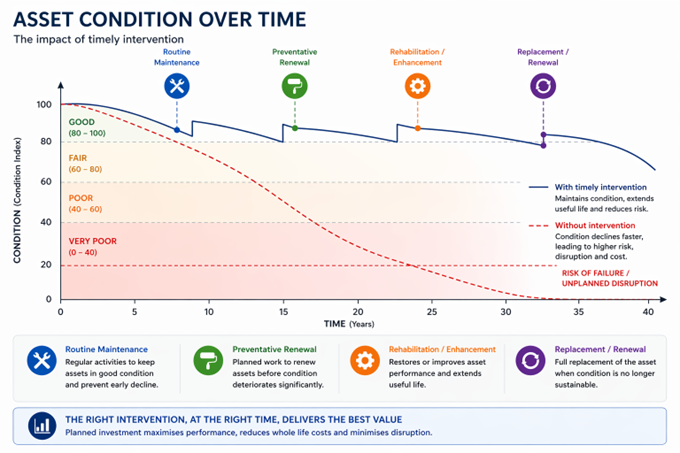
Asset management is simply the way we plan how to look after the highway network, rather than only reacting when problems appear.
Instead of waiting for things to fail, we:
- Keep a close eye on the condition of roads and footways
- Plan maintenance ahead of time
- Focus on safety and long‑term value
- Make sure public money is spent where it has the biggest impact
It’s a proactive, sensible approach that helps us make better decisions for the whole county.
It’s not just about roads
When we talk about highways “assets”, we mean much more than tarmac. We look after:
- Roads and footways
- Streetlights and traffic signals
- Drains and ditches
- Road signs and markings
- Bridges, tunnels and other structures
- Trees, hedges and grass verges
Managing all of these together helps us understand how the network works as a whole, and spot issues before they become bigger problems.
Why do we work this way?
Everyone knows that our roads are under increasing pressure. Many are reaching the end of their original lifespan, the weather causes more wear and tear, and budgets are limited.
Asset management helps us balance all of this by putting safety first and getting the best value from every pound of public money. We do this by prioritising the busiest routes and reducing the need for repeat repairs and short‑term fixes.
How we decide what gets fixed first
We don’t base decisions on a single factor. Instead, we look at things like:
- How severe the safety risk is
- How busy the road or footway is
- Its condition and age
- Whether it’s a key route for schools, buses or emergency services
This helps us make fair and consistent choices across the county.
What does this mean for you?
Using an asset management approach brings real benefits for residents:
Safer journeys: Spotting risks early and prioritising serious defects helps keep people safe.
Better use of public money: Planned maintenance often costs less than emergency repairs and helps roads last longer.
Less disruption over time: Fixing the right problem at the right time can reduce repeated roadworks in the same place.
Clearer decisions: We know it’s frustrating when your road isn’t repaired straight away, but having a structured approach helps explain why some jobs have to take priority.
When we can’t fix everything: Sometimes, especially on quieter roads, we have to carefully manage what we can do so funding is focused where it protects the most people.
That isn’t neglect – it’s about making responsible choices so we can keep the network safe and functioning for everyone.
Looking ahead: Asset management is about thinking long‑term. By planning ahead, using data and investing wisely, we’re working to keep East Sussex moving – today and in the future.
Things to remember
Not all roads are public highway: Some roads throughout the county are privately owned and maintained. This can be either by the local council or by the residents who live there. You can find out if a road is publicly maintained by visiting: East Sussex County Council Adopted Roads
We’re not the only highway authority: ‘Trunk roads’, for example the A27 and A21, are managed at national level, with maintenance planned and carried out by National Highways.
For more information on our asset management approach, please visit: Roads in East Sussex | East Sussex County Council
A blog by Ros, Asset Manager at East Sussex County Council