

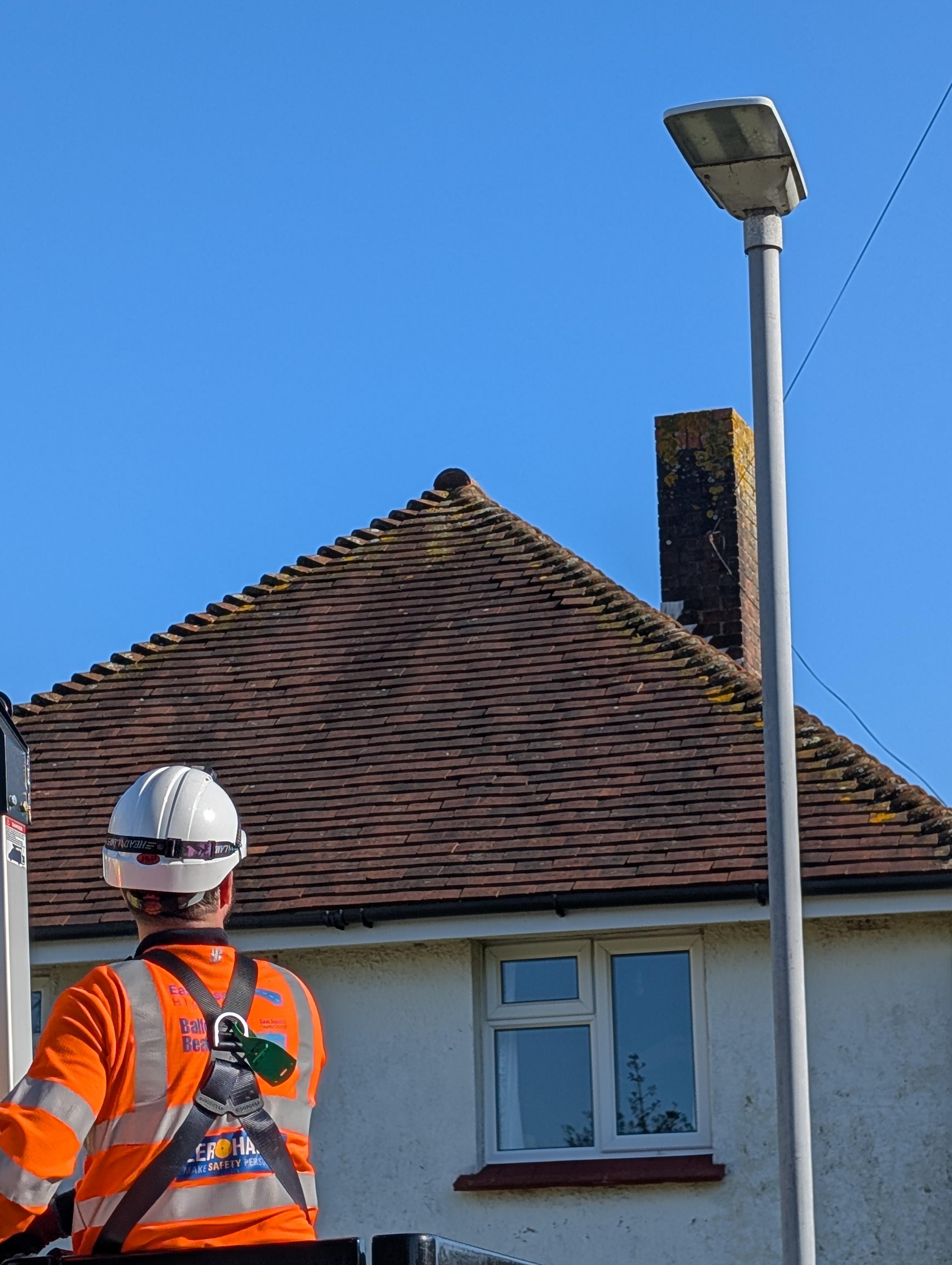
As the clocks go back and the evenings become darker earlier, street lighting becomes a much more noticeable part of daily life across East Sussex.
It's also the time of year when the Street Lighting team see an increase in enquiries, as residents are more likely to spot when a light isn't working during their commute, school run or evening walk.
What many people don't realise is that our streetlights don't need to be manually adjusted when the seasons change. The county's lighting network is fitted with photoelectric cells (PECs), which automatically detect natural light levels and switch lights on and off when needed. As daylight hours shorten, the lights respond to the darker conditions.
Behind the scenes, the team looks after far more than just streetlights. Across East Sussex there are around 50,000 illuminated assets, including more than 41,800 lighting units such as street lighting columns, wall-mounted lights and pole brackets, as well as over 7,700 other illuminated assets including pedestrian crossing beacons, illuminated signs and lit bollards. The team is also responsible for lighting subways and underpasses, where levels are carefully managed to help people adjust between daylight and evening conditions. In the summer, you may notice some unlit subway lights during the day as the surrounding environment is much brighter, whereas all lights may remain lit during the day in the darker months.
With energy efficiency remaining a key priority, much of the network already incorporates measures designed to reduce energy consumption. The county-wide conversion to LED lighting has significantly improved efficiency, while part-night lighting operates in many residential areas outside of Eastbourne and Hastings. In these locations, selected lights switch off during the quietest hours of the night, typically between midnight and early morning. The locations chosen for part-night lighting were carefully considered in consultation in the early 2010s with local communities, Sussex Police, bus operators and other stakeholders, ensuring that main routes remain illuminated while some smaller residential roads and cul-de-sacs can operate with reduced lighting.
Many newer lights also dim automatically later in the evening, often from around 10pm onwards, helping to save energy while maintaining suitable lighting levels. Where appropriate, new highway schemes now implement more even coverage than older light installations, often meaning fewer lighting units are needed while still providing effective illumination through a higher light output.
While members of the public play an important role in reporting faults, the team is also proactively monitoring the network. A dedicated night scout patrol covers the entire county on a rolling 20-day programme, inspecting the network after dark and identifying issues that may not have yet been reported. In some ways, winter makes this task easier, as the earlier darkness allows more of the network to be inspected during operational hours.
As with any outdoor infrastructure, winter weather can create additional challenges. The most common issue remains individual lights that have stopped working, but storms and strong winds can also result in fallen trees, damaged columns and other faults requiring attention.
When a street lighting fault is reported, it is reviewed by the team and assessed to identify the cause. In many cases repairs can be arranged promptly, although some faults may involve wider power supply issues or specialist repairs. For standard faults, the team aims to attend within 10 working days. Reports from residents, customer services and the night scout patrol are reviewed daily to ensure issues are prioritised and scheduled appropriately.
As we head into the darker months, residents are encouraged to report any faults they notice and provide as much information as possible about the location. Every report helps the team maintain the network and keep East Sussex's roads, footways and public spaces illuminated throughout the winter.